When faced with many job orders, how much material and time can be lost if it is not possible to quickly compare the different production combinations?
For service centres and companies that process coil, planning must take into account frequently fragmented orders, small batches and materials with different characteristics. In addition, the presence of partially used coils can affect the processing sequence and increase remnants.
Nesting becomes part of planning
In this scenario, optimising nesting does not simply mean finding the most efficient arrangement of parts on the material. It also means evaluating which combination of orders to produce, with which coil and on which line, taking the actual production conditions into account.
This is the need addressed by Infocoil, the software developed by Informa Srl in partnership with Gabella Macchine. Starting from job orders and warehouse availability, the system generates several nesting solutions that can be compared on the basis of material yield. Scheduling can also take into account line parameters and coil characteristics, so as to identify solutions consistent with production constraints.
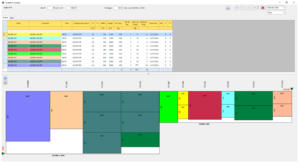
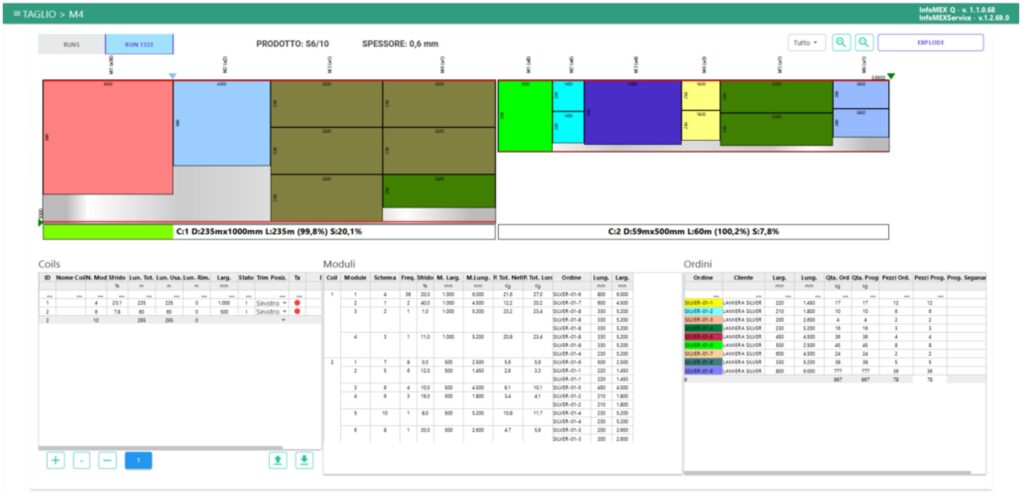
The operator retains the ability to modify the proposals and intervene on the solution, while the software reduces the work required to build and compare the different combinations. Solutions can be generated quickly and compared, including through simulations of different scenarios.
Tests carried out by Gabella showed scrap reductions of up to 10% under particular conditions, while in the most recent applications an average reduction of around 3% is reported.
From solution calculation to production
Optimisation can be extended to the execution phase through Infomex, the MES module that links planning to production. Infocoil and Infomex are independent but complementary solutions: the former supports the optimisation of production combinations, while the latter makes it possible to control and monitor operations, from order management through to production and warehouse.
The sequence generated can be transferred to production, while execution data can be acquired by the system and used to keep process and material information up to date. This makes useful data available for subsequent planning as well.
This link is particularly useful when the schedule changes in progress: a job order may be modified, an operation may need to be repeated, or the sequence may need to be recalculated quickly. In such cases, the ability to reprocess the solutions makes it possible to react to changes without having to manually rebuild all the combinations.
From the job order to the line, and from the line back to planning: this is the logic underlying the integration between Infocoil and Infomex. The infographic illustrates the workflow, showing how coil optimisation can fit into a broader process and what results have been recorded in real-world applications.